The AI Vulnerability Surge
Published CVEs are running 175% above their pre-AI trend in 2026. This 7-page report measures how much of the growth AI explains, what the new volume is made of, and what security and compliance teams should change.
Get the free white paper- 106,200CVEs projected for 2026, up from 25,073 in 2022
- +175%above the pre-AI growth trend
- 55 to 64%of this year's CVEs that the old trend cannot explain
Get your free copy
7 pages. Instant PDF download.
What the Data Shows
Volume has quadrupled
2026 is on pace for about 106,200 published CVEs: 4.2 times 2022 and 2.75 times what the pre-AI trend predicts.
It is still accelerating
October 2026 is running at about 590 new CVEs a day, double the year-to-date average of 291.
How much of it is AI
Between 55% and 64% of this year's CVEs sit above anything the old growth rate or known policy changes explain.
Not low-grade noise
One October week produced 1,890 Critical or High CVEs in 2026, seven times the same week in 2022.
Scoring has fallen behind
90% of this October's new CVEs have no completed NVD analysis, and 45% of last October's still do not.
What to change
Five steps for security and compliance teams, tied to NIST SP 800-171 (CMMC), SOC 2 and PCI DSS requirements.
Inside the Paper
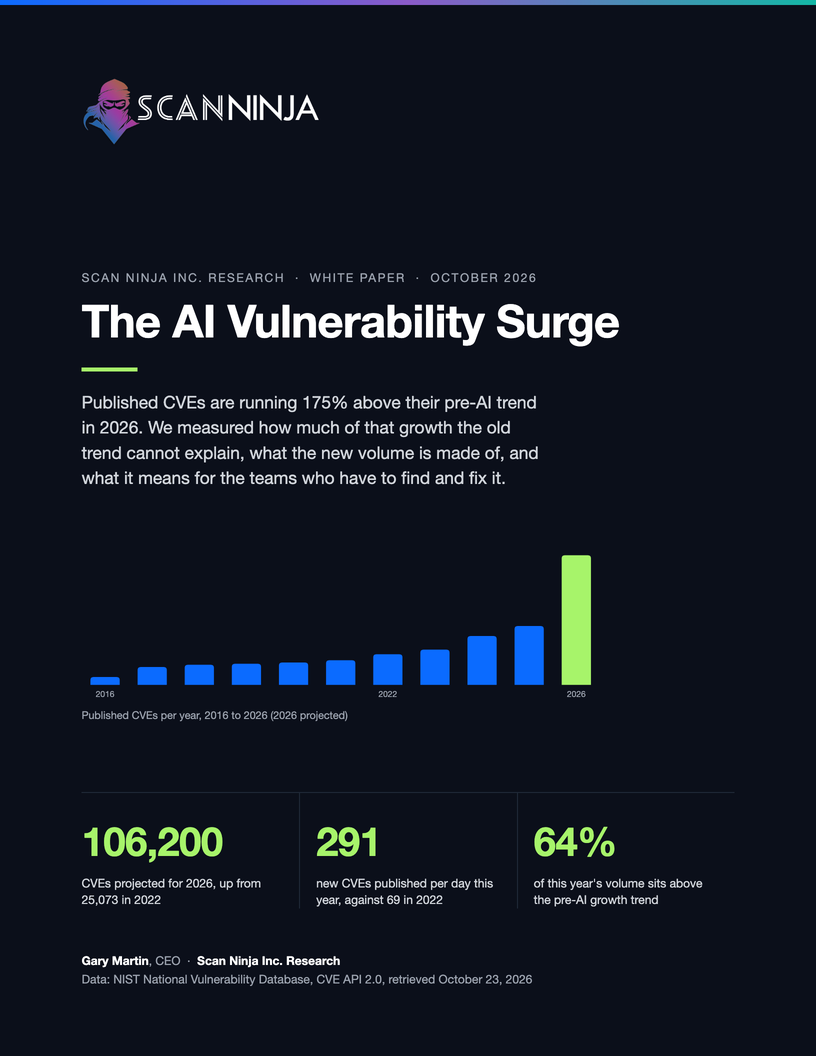
- The break in the trend: annual CVE volume from 2016 to 2026 against the pre-AI growth rate
- Month by month: the shape of the 2026 acceleration
- How much of this is AI: a bridge from 2022 to 2026, with the largest policy change removed
- Where the growth was published: the numbering authorities behind it
- Real risk or noise: Critical and High CVEs in a like-for-like week
- The scoring gap: how far NVD analysis has fallen behind
- What this means for security and compliance teams: five recommendations
About the Research
Every figure comes from the NIST National Vulnerability Database through its public CVE API 2.0, the same feed Scan Ninja's vulnerability database synchronizes from. CVEs are counted by the date NVD published them, rejected records are excluded, and 2026 runs to October 22. The pre-AI trend is the 2017 to 2022 growth rate projected forward. Data collection, analysis and drafting were carried out with agentic AI workflows and reviewed by the Scan Ninja Inc. research team.